nod.

Your build asks you one question. You tap. It gets on with it.

An AI is building your thing. Every so often it hits a fork only you can settle. Nod is where it asks — in your words, with the cost of each answer written down, in about twenty seconds.

If you run a business

You didn't hire an AI so you could go and learn project management software.

Boards, tickets, statuses, someone asking you to review a list — that is a second job you never applied for. Meanwhile the actual questions get buried in a thread nobody reads, and the work quietly stops.

If you build with agents

Your agent is fast until it needs an answer. Then it is dead for two days.

You either guess and redo it later, or you chase the client on WhatsApp with a paragraph they will not read. The bottleneck was never the model. It is the fifteen small decisions a week only the owner can make.

This is the whole product.

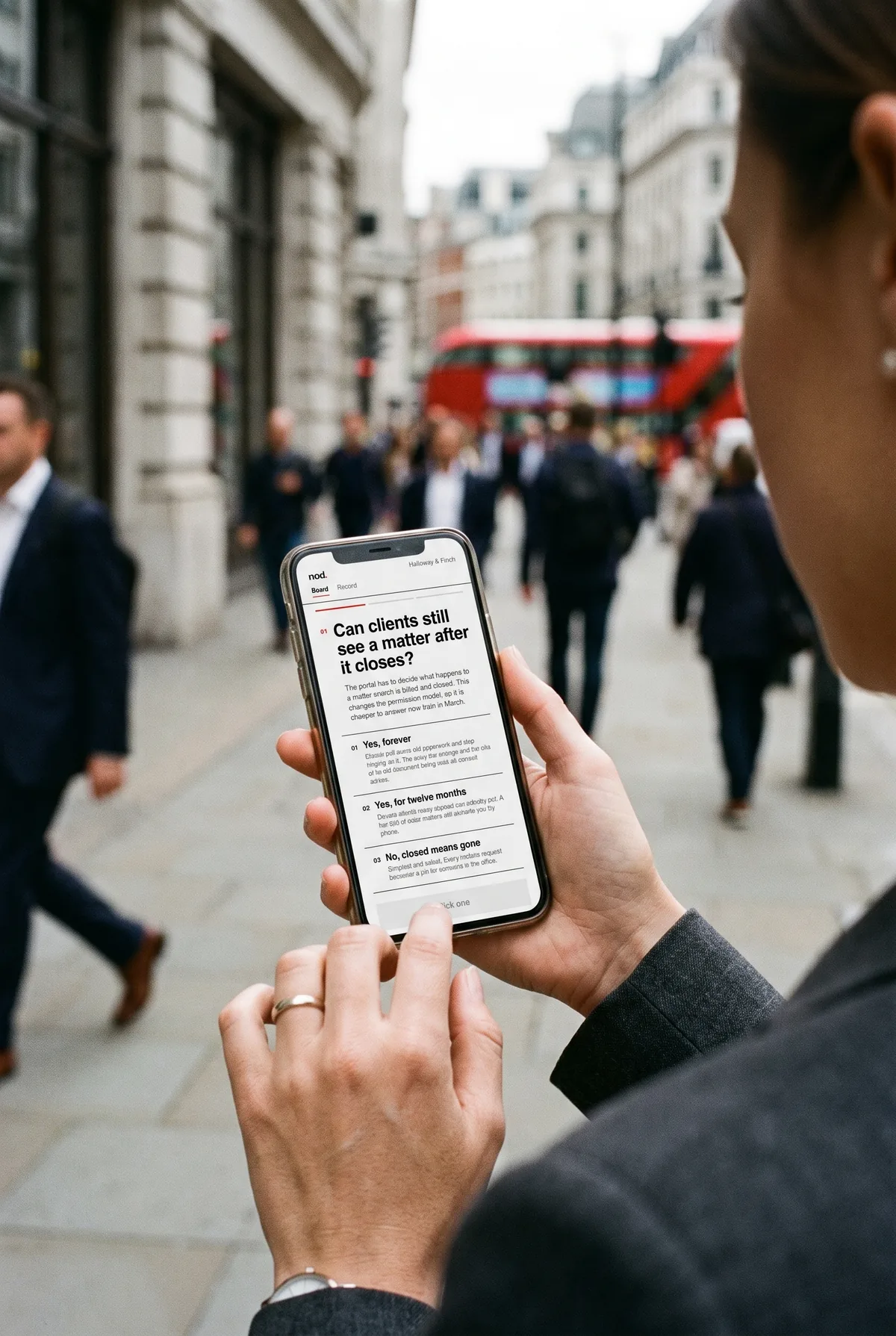
One question at a time. Every answer says what it costs you, so you are never guessing. Pick one and the work starts again before you have put your phone down. Go on — answer it.

01Your agent gets stuck on something only you can settle.
02It sends you a call: twelve words, two to four answers, each with its cost.
03You nod one — in the app, from the lock screen, or by replying to a text.
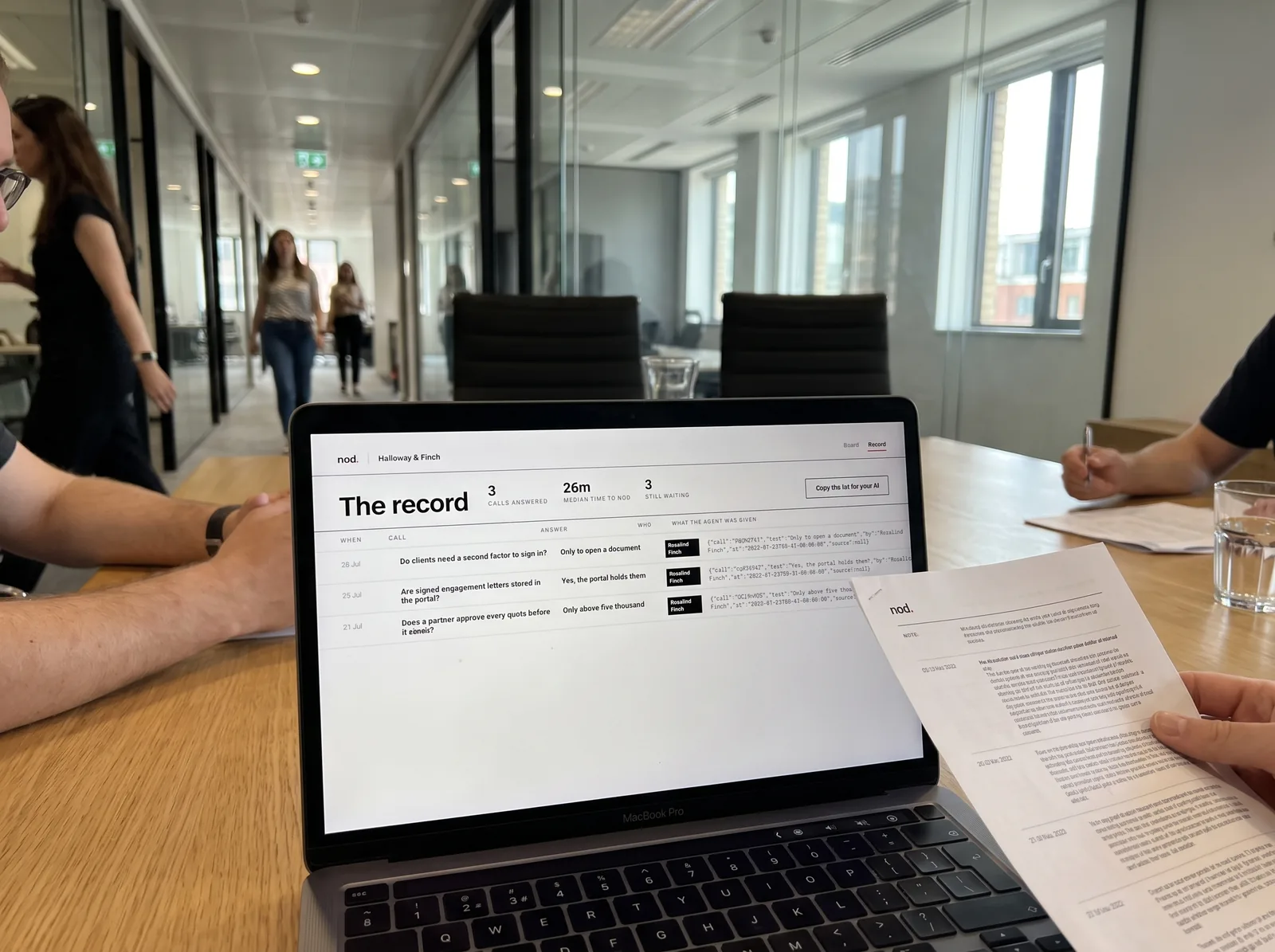
04The answer goes straight back and it carries on. It is written down for good.
03

Late cancellation — do you keep the money?

Whatever you pick goes on the booking page in plain English, so it has to be one you will defend.

Nodded.

What happens now
The booking page says it in plain English by tonight, and the three customer texts get rewritten to match.

That took you eight seconds. The agent had been sat waiting on it since Tuesday.

Why it works

Not because of the screen. Because of what the screen refuses to do. These are not guidelines — a call that breaks them is rejected before it ever reaches you.

12
words, maximum
If it cannot be asked in twelve words it is not one question yet. It gets split in two.
2–4
answers, never five
More than four and you are doing the agent's thinking for it. Fewer is usually better.
Every
answer states its cost
"Loses about one booking in twenty." No downside hidden, so you can decide in seconds.
0
jargon, ever
No deploys, no configs, no backlog. If you would not say it to a customer, it is not said to you.
For the business owner
Twenty seconds, not an afternoon
No software to learn, no login to remember. A text arrives, you answer it at the lights.
You always know what it costs
Every option spells out the downside in money, time or hassle. You are deciding, not guessing.
It gets quieter the longer it runs
Settled things stay settled. It stops asking what it already knows about how you work.
A written record of every call
Six months on, when someone asks why the site does that — it is there, dated, in your own words.
For the AI developer or agency
Your agent stops being blocked
Median answer under five minutes. It asks, waits a moment, and keeps going instead of guessing.
One line in your agent's setup
Nod is the server — point any agent at it and it gets an ask tool.
No more chasing on WhatsApp
Clients answer questions they understand. You stop translating decisions into small talk.
Nobody can say they never agreed
Every decision timestamped with who made it. Scope arguments end in about four seconds.

What it deliberately isn't

Every one of these has been asked for. Each would turn a decision back into a task, which is the thing the owner already refused to do.

No statusesAnswered, or not.
No due datesIt shows what is stopped instead.
No comment threadsIf it needs discussing it is not a call.
No backlogOnly what is blocking work right now.
No votingOne named person decides.
No dark modeIt is not a tool for developers.
Want it on your build?

Nod is invitation-only while it is young. Tell me what you are building and who has to answer for it, and I will send you a link.

Ask for a link

Already been sent one? It signs you straight in — there is no password to remember.